Kayne has been investing in renewables since 2013 and is actively expanding activities across marketable equity, credit, and private transactions.
Renewable Energy
A growing team of renewable energy specialists in public equity, private equity, and credit, supported by large energy & infrastructure team.
Why Renewable Energy
Renewables Represent a Large and Growing Infrastructure Investment Opportunity
- Global investment in renewable power generation has outpaced traditional carbon-based power by 2-to-1 in recent years*.
- Bloomberg New Energy Finance (BNEF) estimates $10.3 trillion of investment through 2050 – representing nearly 80% of all new generating capacity**.
*Source: EIA
**Source: BNEF, 2019 Outlook
Investments in Renewables Infrastructure are Attractive When Structured Properly
- Long-lived assets (25 to 50 years).
- Predictable, recurring revenue, often secured by long-term contracts and/or linked to inflation.
- Modest variable costs during the operating lives given a renewable energy source.
- Continuous improvements in cost and efficiency enable long-term structural growth.
Renewable Fuels are the Fastest Growing Source of U.S. Electricity Generation
- In the U.S. specifically, renewables (wind and solar) installations are expected to increase by over 40 GW over the next five years.
- Coal and nuclear retirements in the next five years expected to exceed 40 GW.
- Wind and solar generation capacity expected to increase from <10% of U.S. electricity generation to ~25% by 2050.
The Majority of U.S. States Maintain Targets or Goals for Renewable Generation
- 30 states (and D.C.) have renewable portfolio standards (RPS), with an additional eight states with renewable portfolio goals.
Renewable Portfolio Standards
or Goals by State
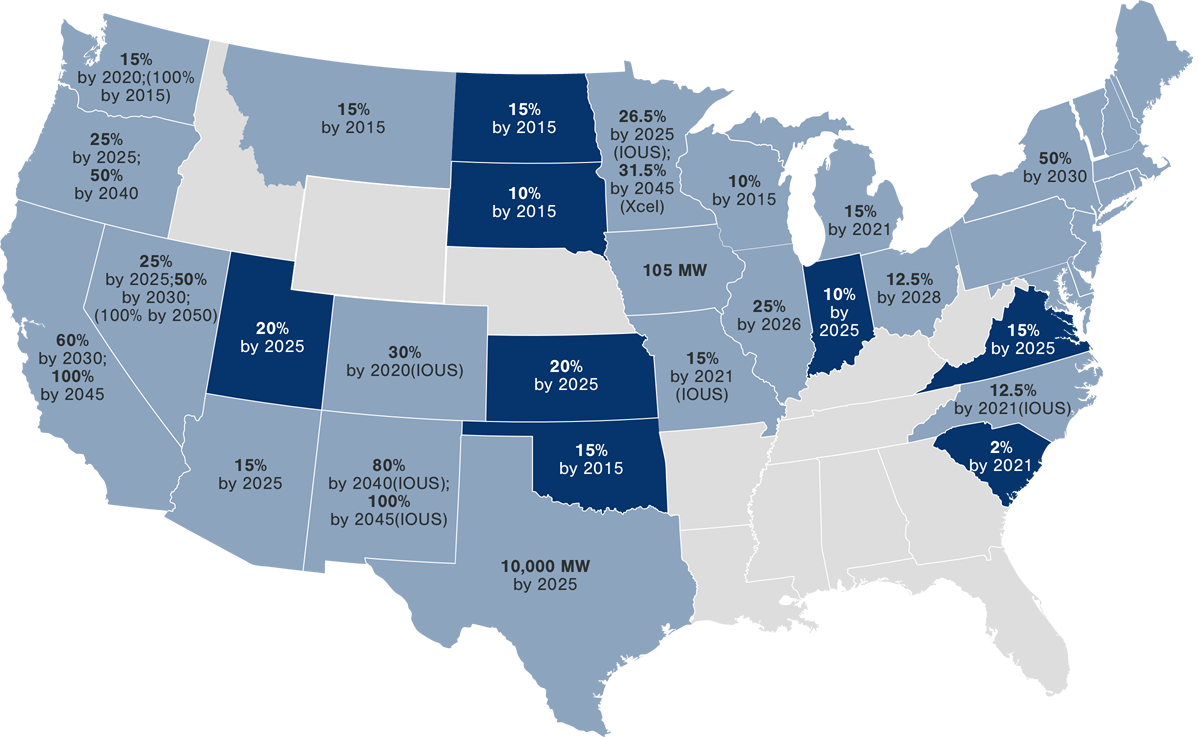
ME: 80% by 2030; 100% by 2050
VT: 75% by 2032
NH: 25.2% by 2025
MA: 35% by 2039 + 1% for each year thereafter
RI: step-ups to 38.5% by 2035
CT: 44% by 2030
PA: 18% by 2021
VT: 75% by 2032
MD: 25% by 2020; 50% by 2030
DE: 25% by 2026
DC: 20% by 2020; 100% by 2032
VA: 15% by 2025
HI: 30% by 2020; 40% by 2030;
70% by 2040; 100% by 2045
 Renewable Portfolio Standard
 Renewable Portfolio Goal
Source: DSIRE, NCSL, Barclays Research.
Renewables Infrastructure Demand is Driven by Several Factors
Supportive government policy.
Near-term through Federal tax credits and longer-term through state renewable portfolio standards.
Unit cost improvements.
Increasingly cost-competitive with coal/gas; requirement for subsidy support declining globally.
Corporate mandates.
Large global corporations increasingly establishing goals of sourcing 100% of power from renewables.
Technological advancements.
Investments in smart grids, battery storage, and other technologies help enhance the viability of renewables.
Environmental impact.
Renewables are reducing greenhouse gas emissions from electricity generation and replacing retired coal plants.